Tuna and Wahoo Trolling: How a Full Day on the Water Works


 Published: Nov 3, 2026
 8 min read
Summary
An expert look at how trolling works for pelagic fish: boat movement, the spread of lines and why a full day suits the style. Written for anglers curious about the Full-Day Tuna & Wahoo Troll from Tuna Wahoo Charters.
What trolling actually is
Trolling is fishing while the boat is moving. Instead of casting and retrieving, or dropping bait and waiting, you pull lures or baits behind the boat at a steady pace and let the movement do the work. The fish come to you because the boat keeps covering new water.
That sounds simple, and the basic idea is. The skill is in how the whole system is put together: how fast the boat moves, how far back each line runs, and how the lines sit in relation to one another. Those choices decide whether a pelagic fish sees a convincing target or a tangle of drag.
This is the method behind tuna and wahoo trolling, and it is the style Tuna Wahoo Charters builds its Full-Day Tuna & Wahoo Troll around. Captain Thenna Df runs trips out of West Palm Beach, Florida, and this article walks through what the technique involves so you know what a day like that looks like before you step aboard.
Why pelagic fish suit this method
Pelagic fish live in open water rather than around a fixed structure. They move, often quickly, and they feed on whatever passes through. A fish that roams like that is hard to find with a stationary bait, because you are betting it swims past your exact spot.
Trolling flips that problem around. A moving boat sweeps lures through a long stretch of water, so you meet far more fish than you would sitting still. It also makes use of how these predators behave, since a lure pulled at speed looks like prey on the run, and a fast fish tends to react to something that is trying to get away.
That is why trolling is a standard approach for offshore fishing aimed at fast open-water species. Tuna and wahoo both fit that description, so the technique and the target match well.
Boat movement and speed
The boat is the engine of the whole method. Trolling speed is usually slow compared with simply running from one place to another, but it is not idle. The captain holds a steady pace that keeps the lures swimming or skipping the way they are meant to.
Speed changes how a lure behaves. Go too slow and a lure can sink or lose its action. Go too fast and it can skip out of the water or spin badly. A good captain watches how the lures are running and adjusts the throttle until they look right in the wake.
Direction matters too. Turning the boat changes the speed of the lines on the inside and outside of the turn, which can make a lure surge or drop back. Experienced captains use gentle turns on purpose, because a lure that changes pace can trigger a strike from a fish that ignored it while it ran straight.
Building the spread of lines
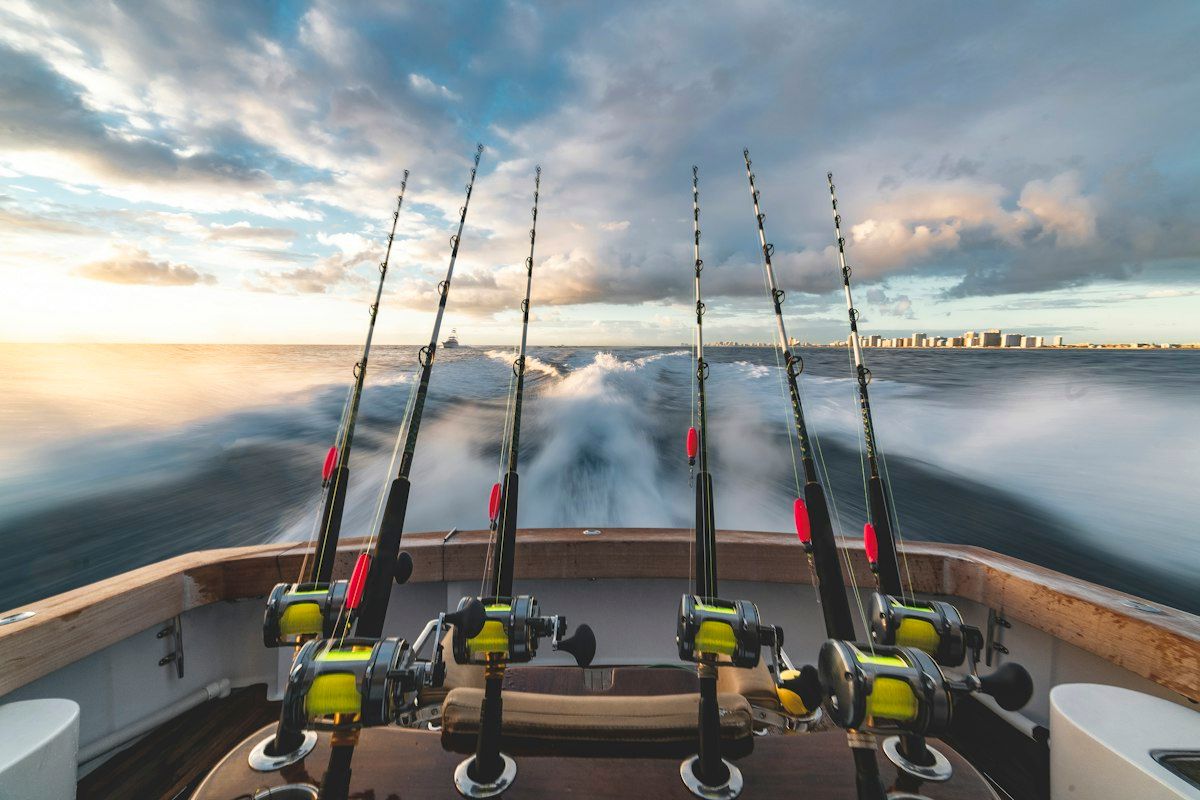
Nobody trolls with a single line when they can run several. The group of lines behind the boat is called the spread, and setting it up well is a big part of the craft. Each line runs at a different distance behind the boat and sits at a different position across the wake.
The point of staggering them is twofold. It keeps the lines from crossing each other, which saves a lot of frustration. It also puts lures at different distances and depths, so you cover more of the water column and offer fish more than one look at once.
Several things shape how a spread is arranged:
- How far back each lure runs behind the boat
- Which lines run in the clean water and which run in the wake
- How the lines are spaced so they stay clear of each other
- Which lure or bait sits in each position
The captain can rearrange all of this during the day. If one position keeps getting attention, the spread can be shifted to lean into it. Nothing about a spread is permanent, and a good one gets adjusted as the day tells you what is working.
Reading the water while you troll
Trolling is not a matter of setting lines and staring at them. The captain and crew are constantly looking for anything that suggests fish: changes in the water, signs of life on the surface, or features that tend to hold open-water predators. The boat then works along those areas instead of covering empty water at random.
This is where local knowledge earns its keep. A captain who fishes out of one port, as Tuna Wahoo Charters does out of West Palm Beach, learns how the water in that area behaves and where it makes sense to put a spread. That judgment is something you cannot get from a diagram, and it shapes how the day is run.
It also explains why trolling is more active than it looks. The boat is always working, the lines are checked, and the plan shifts as conditions change. The angler's job is simple enough, but behind it there is a lot of decision-making going on.
Why a full day suits this style
A full-day trip fits trolling because the technique is built on covering water and waiting for the right moment. Fish do not strike on a schedule, and trolling rewards patience. Time is the one ingredient you cannot shortcut.
A longer day gives the boat room to do the things the method depends on. There is time to run out to open water, set the spread properly, and make adjustments once the lines are in. There is also time to work different areas rather than committing to a single stretch for the whole trip.
Offshore fishing involves travel as well. Reaching blue water takes a while, and a short window can end up mostly spent getting there. A full day on the water means the trolling itself gets real time instead of being squeezed in at the edges.
The Full-Day Tuna & Wahoo Troll
The Full-Day Tuna & Wahoo Troll from Tuna Wahoo Charters is built around exactly this technique. It is a full-day boating trip focused on trolling for pelagic fish, run by Captain Thenna Df out of West Palm Beach, Florida. If the method described here appeals to you, this is the trip that puts it into practice.
Everything above is what you are stepping into: a moving boat, a planned spread of lines, a captain reading the water, and enough hours to let the technique do its work. You do not need to master any of it beforehand, because setting the spread and running the boat are the captain's responsibilities. For details on what the trip includes and how to book, check the Full-Day Tuna & Wahoo Troll listing.
Understanding the method makes the day more interesting, too. When you know why the lines are staggered and why the boat turns the way it does, you watch the spread with a better sense of what you are looking at. That knowledge is a good thing to bring along for a full day offshore.